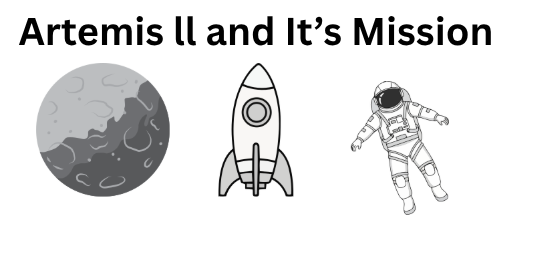

The last orbit around the moon was over 50 years ago by NASA, but on April 1, 2026, the Artemis II mission launched with four astronauts aboard the Integrity spacecraft, destined to spend 10 days in outer space and fly around the moon. This momentous feat marks advancements in space travel, as the moon flyby captured space pictures and tested the Orion spacecraft’s life support, and will advance and strengthen the arsenal needed for deep space travel. This orbit has also taken the hearts and minds of many, with fun clips of the astronauts and interviews of them aboard the Integrity all being posted online. This mission has marked other milestones: Christine Koch, the mission specialist, is the first woman to orbit around the moon, and Victor Grove, the pilot of the spaceship, is the first black astronaut to orbit the moon. The other astronauts on the mission include Reid Wisemen, the commander, and Jeremy Hansen, the mission specialist. Artemis ll aims to push humans the furthest they’ve ever been in the great expanse of space, and alongside the historic progress this mission of photographing the dark side of the moon is achieving, it’s also reinvigorating public interest in space travel!
In a stark contrast to the Artemis’s so far smooth trip, a disaster burnt into every Gen X’s and Boomers brain is the explosion of the Challenger. The Artemis ll launched successfully, but that wasn’t the case 40 years ago where shortly after the Space Shuttle Challenger launched on January 28, 1986, it exploded, killing all seven crew members. This moment was aired on TV, and there’s a good chance that your parents saw it live on TV at school or home. But Artemis ll highlights the progress and work towards space travel as well as inspiring a new generation of people on the wonders of space.
When asked about how he views the Artemis ll in past failures like the Challengers explosion, Mr. Daniels responded, “Artemis is pretty exciting, as a kid growing up watching Apollo, I think it (the Artemis) is a national and global endeavor, it’s a positive in the midsts of everything else at the moment.”
When asked about whether the Challenger exploding affected his view of future space travel, Mr. Daniels answered, “The Challenger exploding was upsetting because you’d hate anything like that to happen. Understanding the risks involved is pretty clear. It didn’t diminish my interest or the excitement of making these sorts of adventures, it brought back how real it is and what the risks are.”
When asking Dr. Plassmann what she thinks Artemis means for the future of space travel, discovery and science, she responded, “The US is currently launching a kind of revival of the space flights and exploration. So now we have this mission to the moon and back, and long term a mission to Mars.”
“I personally think we should be cautious because we need to consider what scientific benefits might. We already have unmanned satellites and telescopes telling us a lot of in depth about planets and atmospheres and distant stars. It’s not clear Artemis gained that much information,” added Dr. Plassmann.
When asked if she thinks that Artemis will be inspiring for future generations, Plassmann said, “Yes I do think it plays a role in inspiring young people. Apollo missions inspired hundreds and thousands and millions of people, especially young people all over the world! So many kids in the US wanted to become astronauts and that enthusiasm continued. It’s still true Nasa continued to attract astronauts, a lot of young people, a lot of technical people in employment. I think that galvanizing factor is good, but surely we can inspire kids just as well with unmanned space exploration, with space based telescopes.”
The public opinion on Artemis ll is mixed, some teacher commend it’s push into uncharted territory and it’s ability to rise above past failures, while other teachers question its usefulness in an space age where unmanned technology equally provides us with great information. But, regardless, there’s a consistent notion that Artemis ll is a large leap in space exploration.