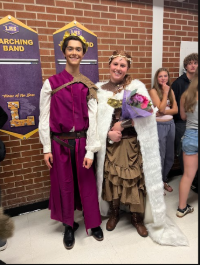


The Senior Games – whether students realize it or not – have begun. But the idea created to increase school participation in sporting events and spirit days has yet to reap the intended benefits.
What are the Senior Games?
The Senior Games is an idea that was created and promoted by an LHS teacher to increase student participation in outside-of-school activities and in-school spirit days. The idea itself is wonderful; I completely agree with the notion that more LHS students should be more active in LHS events. But it’s the execution that’s the issue. The Senior Games work through counting the amount of senior girls versus boys that attend predetermined events.
To me, there are three primary issues in this. The first issue: it’s only seniors who are meant to be participating. More specifically, it’s meant to be a secret senior thing (sorry to spill the beans) but it doesn’t seem to be increasing involvement. The second issue is the gendered nature of the competition. Nowadays, especially at our school, gendered competitions aren’t all too popular because of the queer inclusivity that our school promotes. The third issue is easily the most blaring: nobody knows that the Senior Games are going on! Seniors either don’t know what the predetermined events are or don’t know that the Senior Games exist. Regardless of the reason, it’s not the promotion it’s supposed to be.
The issue with only seniors:
I would like to repeat that I think the idea itself is solid. Get one group of influential students to start participating, the whole school will. Only, the seniors have yet to increase their participation. Seniors are either busy as bees and/or counting down the days until graduation. Meaning, not a lot of them want to spend their precious free time at the school.
The last LHS sport event I went to was a couple weeks ago: an LHS Boys Basketball game. The stands, while not filled to the brim, were moderately full of LHS students. It was a good environment, one I’d like to see at more LHS events. However, the majority of LHS attendees were not seniors, but juniors. I believe that the exclusivity of the Senior Games won’t actually promote participation because it’s just competition within the class. If we want to see a large increase in participation, then we must include the underclassmen.
The issue with boys versus girls:
Lots of queer students (specifically those under the trans umbrella), staff members at the events, and seminar teachers have found themselves in weird situations around these Senior Games. Students who aren’t out of the closet have to choose between presenting as a boy or a girl to the staff member taking a tally at the event and to their seminar teachers. Other students who identify as nonbinary or genderqueer in another sense have to face the same problem, but instead their identities are completely disincluded from the list.
As a transgender individual, the Senior Games put me in a weird position. I’m socially transitioned, but lots of people still don’t know how to refer to me. When it’s time to pass out the Jolly Ranchers, I feel bad for my seminar teacher, who is left guessing whether I feel comfortable enough to accept the candy. Or when it’s time to count up the seniors at the games, I feel bad for the staff member who has to ask me which gender I want to help win for the week.
The issue with being secretive:
The Senior Games have yet to witness mass amounts of seniors attending the sport events, and the secrecy surrounding the whole thing prevents the rest of the school from following the senior’s path.
Seeing as I’m a senior myself, I’ve spoken to dozens of my classmates, and I’ve found that a staggering amount of seniors have no idea the Senior Games are happening at all. Most of these seniors would be more than willing to participate either for increasing school spirit or for competition itself. However, the idea that the games are meant to be secret are limiting the already limited senior participants.
Participation won’t increase if students who are supposed to be “in” on the secret don’t know what is going on.
Alternatives:
There are ways that the Senior Games can be fixed. I believe that by including the whole school and/or creating competing groups not based on gender, we will see an increase of spirited students.
We could create competition between classes. For example, every week we have two or more sporting events. For the winter season, there could be a home boys basketball game and a home girls basketball game in the same week. The competition could be juniors versus freshman at the boy’s game and sophomores versus seniors at the girl’s game. This would promote participation from each class, as they all just want to prove that their class is better than the others.
We could also have competitions between seminar classes. Each seminar teacher falls into subject categories, i.e. History and Language Arts. This can be used as a base of competitions. On predetermined Wednesdays, students from Math seminars could wear purple, while students from Science seminars could wear yellow. Their seminar teachers could then report back, and the winning subjects would get candy the following week.
A final option would be to just promote out-of-school activities or in-school spirit days louder and more often. Students are told about sports games through the daily announcements or by friends, but no one considers that they could go to them. We have specific spirit days, Wish Week being the perfect example, but that’s only once or twice a semester. With both, by having just more school spirit, overall participation would increase throughout the student body. We shouldn’t need the Senior Games to promote students supporting each other and the school.
Conclusion:
For a school that claims to be diverse, we’re not doing a great job of being inclusive. By creating a senior focused, gendered competition, we’re excluding most of our student body. I understand the idea of just having something for seniors, but we already have that in so many ways. To increase school spirit and participation, we need the whole school, regardless of class or gender.